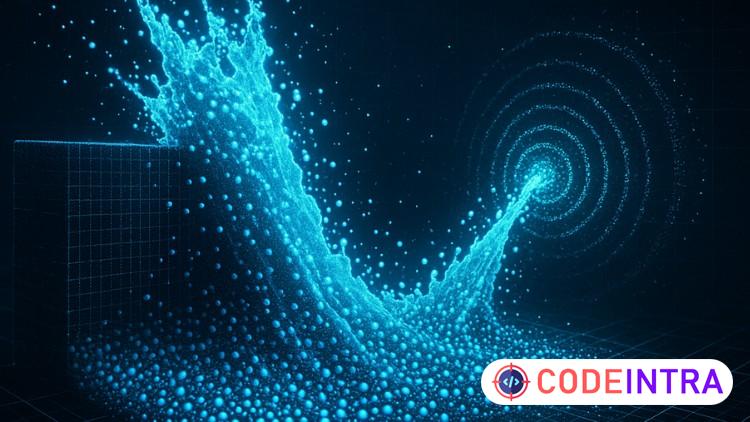
Smoothed Particle Hydrodynamics (SPH) with PySPH
Learn meshless CFD fundamentals and build full SPH simulations using Python and PySPH

Make Someone's Day
Share this incredible course!
This comprehensive course is designed to guide you from the fundamental principles of Smoothed Particle Hydrodynamics (SPH) to the development and execution of complete SPH simulations using PySPH, an open-source, Python-based SPH framework developed at IIT Bombay. Whether you are new to meshless methods or an experienced CFD engineer looking to expand your skill set, this course offers a structured and practical pathway to mastering SPH-based simulations.
You will begin by developing a solid understanding of the mathematical foundations of SPH, including particle approximation, kernel interpolation, and gradient formulations. The course carefully explains how SPH replaces traditional mesh-based discretization with particle interactions, making it especially powerful for problems involving large deformations, free surfaces, and complex physics. Concepts such as interpolation methods, kernel functions, and density formulations are introduced step by step and directly connected to their implementation in code.
A major focus of this course is hands-on implementation using PySPH. You will learn how to install and configure PySPH along with its supporting libraries, including Compyle and Cyarray, using Conda. To ensure a smooth learning experience across platforms, the course also demonstrates how to run PySPH using Docker, allowing you to work without complex local installations. Throughout the course, you will write real SPH codes in Python, create particle arrays, define physical fields, group equations, and configure solver structures from scratch.
As you progress, you will implement core SPH equations such as momentum, energy, and density summation, explore Gaussian kernels and their properties, and build custom time integrators, including an explicit Euler scheme. These concepts are reinforced through classic benchmark problems such as the Shock Tube and Dam Break simulations, giving you practical insight into solver behavior, numerical stability, and physical interpretation of results.
By the end of this course, you will be able to independently build, run, and analyze SPH simulations using PySPH. You will also gain experience exporting simulation results and visualizing them using tools such as ParaView and Mayavi. This course equips you with both the theoretical understanding and practical workflow needed to apply SPH methods to real-world engineering and research problems using a fully open-source toolchain.
Learning Objectives
🔹Understand the core principles and mathematical foundations of Smoothed Particle Hydrodynamics (SPH)🔹Explain how meshless, particle-based methods differ from traditional grid-based CFD approaches
🔹Implement SPH interpolation techniques using polynomial, Lagrange, and Fourier methods
🔹Compute SPH gradients, derivatives, and density formulations
🔹Create and manage particle arrays and physical fields using PySPH
🔹Implement fundamental SPH equations, including momentum, energy, and density summation
🔹Work with kernel functions, including Gaussian kernels, and understand their properties
🔹Write custom time integrators (e.g., explicit Euler) in PySPH
🔹Organize equations and configure solver structures for SPH simulations
🔹Build, run, and analyze classic benchmark problems such as the Shock Tube and Dam Break
🔹Install and run PySPH using Conda and Docker workflows
🔹Export simulation results and visualize them using ParaView and Mayavi
Prerequisites
🔹Basic knowledge of Python programming, including variables, functions, and modules🔹Introductory understanding of fluid mechanics or numerical methods
🔹Familiarity with using a terminal or command line (Linux, macOS, or Windows) is helpful but not mandatory
🔹Willingness to write and modify Python code for simulation workflows
🔹No prior experience with Smoothed Particle Hydrodynamics (SPH) or PySPH is required
Who This Course Is For
🔹Students pursuing CFD, FEA, or computational mechanics who want to learn meshless simulation methods🔹Researchers interested in particle-based and mesh-free numerical techniques for fluid and multiphysics problems
🔹CFD and simulation engineers looking to expand their skills beyond traditional grid-based methods
🔹Python users who want to apply numerical methods and scientific computing to real simulation problems
🔹Beginners seeking a hands-on introduction to Smoothed Particle Hydrodynamics (SPH)
🔹Professionals exploring open-source alternatives to commercial CFD and simulation tools
Course Details

| Price | FREE |
| Views | 14 |
| Lectures | 7 |
| Duration | 3 hours |
| Last Update | 22-May-2026 |
| Release Date | 12-Feb-2026 |
| Category | Teaching & Academics |
|
30
|
|

This course includes:
📹 Video lectures
📄 Downloadable resources
📱 Mobile & desktop access
🎓 Certificate of completion
♾️ Lifetime access