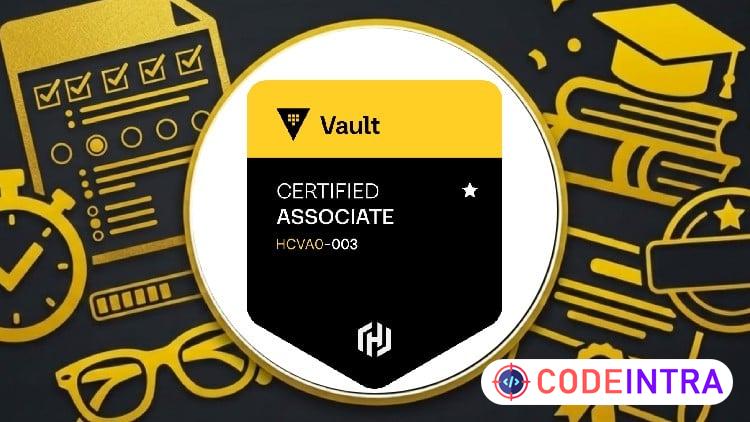
1500 Questions | HashiCorp Certified Vault Associate (003)
Master the HashiCorp Certified Vault Associate (003) exam! 1500 realistic practice questions with detailed explanations.

Make Someone's Day
Share this incredible course!
Detailed Exam Domain Coverage
To become a HashiCorp Certified: Vault Associate (003), you must demonstrate a strong grasp of secret management and data security. My practice tests are meticulously aligned with the official exam domains to ensure you are fully prepared:
Secure Access to Dynamic Data at Scale (36%): Mastering dynamic secrets, lease renewal, revocation workflows, policy management, and identity provider integration.
Vault as a Secret Store (24%): Configuring secret engines, managing encryption, and understanding Vault's underlying data storage and retrieval mechanisms.
Security and Compliance (20%): Implementing Vault’s core security features, audit logging, monitoring, and maintaining compliance across your infrastructure.
Vault Operations and Integration (20%): Utilizing the Vault CLI and API, managing clusters for High Availability (HA), and tuning Vault for peak performance.
Course Description
I designed this course to be the ultimate preparation tool for the HashiCorp Certified: Vault Associate (003) exam. Moving beyond simple theory, these practice tests provide a simulated environment where you can test your knowledge against 1,500 high-quality, original questions. My goal is to help you pass on your very first attempt by providing deep technical insights into how Vault operates in production.
Every question includes a comprehensive breakdown of why certain answers are correct and others are not. This ensures you aren't just memorizing facts, but actually learning the logic of HashiCorp Vault operations, from identity-based secrets to complex policy inheritance.
Sample Practice Questions
Question 1: A developer needs to generate database credentials that automatically expire after 24 hours. Which Vault feature should I implement to achieve this?
A, Static Secrets via the KV Secrets Engine
B, Dynamic Secrets via a Database Secrets Engine
C, Vault Response Wrapping
D, Control Groups
E, Manual policy revocation
F, Transit Secrets Engine
Correct Answer: B
Explanation:
B (Correct): Dynamic secrets are generated on-demand and have a built-in lease (Time-to-Live), making them ideal for temporary, automatically expiring credentials.
A (Incorrect): Static secrets in the KV engine remain until manually changed or deleted; they do not rotate or expire automatically by default.
C (Incorrect): Response wrapping is used to securely transport a secret, not to manage its lifecycle or generation.
D (Incorrect): Control Groups are used for multi-party authorization, not for secret generation.
E (Incorrect): Manual revocation is inefficient and prone to human error compared to automated dynamic secrets.
F (Incorrect): The Transit engine is for "encryption as a service" and does not manage database credentials.
Question 2: Which Vault command is used to check the health and initialization status of a Vault server?
A, vault server -status
B, vault health
C, vault operator init
D, vault status
E, vault read sys/health
F, vault debug
Correct Answer: D
Explanation:
D (Correct): The vault status command provides immediate feedback on whether the Vault is sealed, initialized, and its current HA cluster status.
A (Incorrect): This is not a valid Vault CLI command structure for checking status.
B (Incorrect): While there is a health API endpoint, vault health is not a standard CLI command.
C (Incorrect): This command is used to initialize a new Vault, not to check the status of an existing one.
E (Incorrect): While this API path exists, the question asks for the command-line interface tool.
F (Incorrect): vault debug records information for troubleshooting but is not the standard way to check initialization status.
Question 3: When a token lease expires in HashiCorp Vault, what happens to the secrets associated with that token?
A, They remain active until the root token is rotated
B, They are automatically renewed for another 24 hours
C, Vault immediately revokes the token and any associated dynamic secret leases
D, The secrets are moved to the "cubbyhole" engine
E, Only the token is revoked, but the secrets remain active
F, The system sends an email to the admin but takes no action
Correct Answer: C
Explanation:
C (Correct): Vault’s core security model ensures that when a parent lease (the token) expires, all child leases (secrets generated by it) are also revoked.
A (Incorrect): Secret lifecycles are tied to their own leases or their parent token's lease, not the root token.
B (Incorrect): Renewal must be requested explicitly; it is not automatic upon expiration.
D (Incorrect): The cubbyhole is a temporary storage area, not a destination for expired secrets.
E (Incorrect): Revoking a token also revokes the access it granted to associated dynamic secrets.
F (Incorrect): Vault is an active security tool that revokes access programmatically rather than just notifying.
Welcome to the Exams Practice Tests Academy to help you prepare for your HashiCorp Certified: Vault Associate (003).
You can retake the exams as many times as you want
This is a huge original question bank
You get support from instructors if you have questions
Each question has a detailed explanation
Mobile-compatible with the Udemy app
30-days money-back guarantee if you're not satisfied
I hope that by now you're convinced! And there are a lot more questions inside the course.
Learning Objectives
🔹Gain the expertise needed to pass the HashiCorp Certified: Vault Associate (003) exam on your first attempt.🔹Master the lifecycle of dynamic secrets, including lease renewal, rotation, and revocation.
🔹Learn to configure and manage various secret engines like KV, Database, and Transit.
🔹Understand how to implement robust security policies to ensure the principle of least privilege.
🔹Master the Vault CLI and API for daily administrative operations and automation.
🔹Learn how to secure sensitive data at rest and in transit using Vault's high-level encryption.
🔹Explore advanced configurations for High Availability (HA) and cluster management.
🔹Study real-world scenarios regarding audit logging, monitoring, and compliance requirements.
Prerequisites
🔹Basic knowledge of Linux command line and general networking concepts.🔹Familiarity with cloud infrastructure or basic security concepts (IPs, Ports, TLS).
Who This Course Is For
🔹Security Engineers looking to validate their skills in Secure Access to Dynamic Data at Scale.🔹DevOps Professionals who need to manage Vault Operations and Integration in CI/CD pipelines.
🔹Cloud Architects designing Vault as a Secret Store for distributed applications.
🔹Compliance Officers needing to understand Vault's Security and Compliance auditing features.
🔹System Administrators transitioning from static configuration files to dynamic secret management.
🔹Developers who want to learn how to programmatically fetch secrets via the Vault API.
Course Details

| Price | FREE |
| Views | 1 |
| Lectures | 0 |
| Duration | 1500 questions |
| Last Update | 22-Apr-2026 |
| Release Date | 26-Mar-2026 |
| Category | IT & Software |
|
30
|
|

This course includes:
📹 Video lectures
📄 Downloadable resources
📱 Mobile & desktop access
🎓 Certificate of completion
♾️ Lifetime access