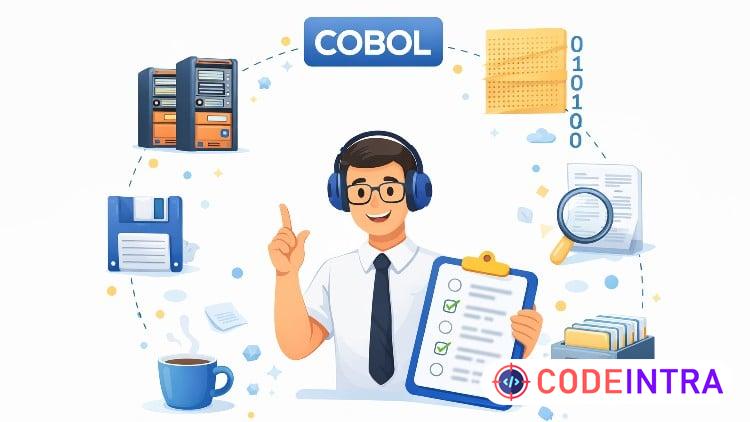
400 COBOL Interview Questions with Answers 2026
COBOL Interview Questions Practice Test | Freshers to Experienced | Detailed Explanations for Each Question

Make Someone's Day
Share this incredible course!
COBOL Interview Mastery: 500+ Practice Questions
Master Enterprise COBOL: The Ultimate Interview & Exam Guide
COBOL Interview Practice Questions and Answers is the definitive resource I designed for developers who need to bridge the gap between basic syntax and high-stakes enterprise performance. I have built this course to mirror the rigorous technical screenings found at Fortune 500 banks and insurance firms, focusing on the sophisticated "why" behind every command rather than just the "how." Throughout these practice tests, I guide you through the intricacies of VSAM file sharing, the nuances of CICS inter-language communication, and the critical performance tuning required for DB2 embedded SQL. Whether you are navigating the transition to COBOL 6.x or mastering the LINKAGE SECTION for modern API integration, these detailed explanations ensure you don't just memorize answers—you actually command the logic. By simulating real-world scenarios involving deadlocks, XML parsing, and dynamic call conventions, I’ve ensured that you will walk into your next interview or certification exam with the tactical confidence of a senior mainframe engineer.
Exam Domains & Sample Topics
Core Syntax & Data Manipulation: Internal Sorting (SORT/MERGE), STRING/UNSTRING, and INSPECT logic.
File Handling & VSAM Operations: File Status codes, Alternate Indexes, and START command mechanics.
Sub-programming & Inter-language Communication: Static vs. Dynamic CALL, LINKAGE SECTION, and CICS integration.
DB2 Integration & SQL Processing: Cursor management, SQLCA, Precompiler workflows, and Deadlock handling.
Enterprise Best Practices & Modernization: COBOL 6.x features, JSON/XML parsing, and performance optimization.
Sample Practice Questions
Question 1: When using the INSPECT statement to replace characters, which of the following is true regarding the TALLYING and REPLACING phrases?
A) TALLYING must always precede REPLACING if both are used in one statement.
B) REPLACING must always precede TALLYING if both are used in one statement.
C) You cannot use both TALLYING and REPLACING in the same INSPECT statement.
D) The TALLYING counter is automatically reset to zero by the INSPECT statement before execution.
E) The REPLACING phrase can only be used on numeric edited fields.
F) INSPECT cannot be used on group items; only elementary alphanumeric items.
Correct Answer: A
Overall Explanation: The INSPECT statement is a versatile tool for data validation and transformation. When combining both counting and modification, COBOL syntax rules dictate a specific sequence to ensure predictable results.
Detailed Explanations:
A) Correct: COBOL syntax requires the TALLYING phrase to come before the REPLACING phrase when both are present in a single statement.
B) Incorrect: Reversing the order results in a syntax error during compilation.
C) Incorrect: You can absolutely use both; it is a common way to count occurrences while simultaneously cleaning data.
D) Incorrect: The programmer is responsible for initializing the TALLYING identifier; the statement increments the existing value.
E) Incorrect: REPLACING is primarily used on alphanumeric or group items, not specifically numeric edited fields.
F) Incorrect: INSPECT can be used on group items, treating them as a single alphanumeric string.
Question 2: In a VSAM environment, what is the primary purpose of the START statement?
A) To open a file for sequential input/output processing.
B) To physically move the first record of an indexed file into the File Section buffer.
C) To establish a currency pointer at a specific record based on a key value for subsequent sequential retrieval.
D) To initialize the Virtual Storage Access Method (VSAM) control blocks in the Data Division.
E) To delete the existing index and rebuild it for better performance.
F) To grant multi-user write access to a KSDS file.
Correct Answer: C
Overall Explanation: The START statement is used for "Random Start, Sequential Read" operations, allowing a program to skip to a specific point in a large file without reading every preceding record.
Detailed Explanations:
A) Incorrect: The OPEN statement is used to prepare a file for processing.
B) Incorrect: START does not retrieve the record; only a READ statement moves data into the buffer.
C) Correct: START positions the file pointer; it tells VSAM where the next READ NEXT should begin.
D) Incorrect: Control blocks are handled by the OS and the SELECT/ASSIGN clauses.
E) Incorrect: START is an I/O operation, not a utility for index reorganization.
F) Incorrect: Multi-user access is defined in the SHAREOPTIONS of the VSAM cluster definition (IDCAMS).
Question 3: When performing a dynamic CALL in COBOL, how does it differ from a static CALL?
A) A dynamic CALL requires the subprogram to be hard-coded into the main load module at link-edit time.
B) A dynamic CALL loads the subprogram into memory only when the CALL statement is executed.
C) Dynamic calls are restricted to internal nested programs only.
D) Static calls are faster during execution because they use the CANCEL statement automatically.
E) Dynamic calls cannot pass parameters BY REFERENCE.
F) A dynamic CALL requires the program name to be a literal (e.g., CALL 'SUBPROG').
Correct Answer: B
Overall Explanation: The choice between static and dynamic calling affects memory management, load module size, and how updates to subprograms are deployed.
Detailed Explanations:
A) Incorrect: That describes a static call, where the modules are bound together before execution.
B) Correct: Dynamic calls offer flexibility by loading the subprogram at runtime, allowing for smaller main modules and easier updates.
C) Incorrect: Dynamic calls are specifically used for external, separate load modules.
D) Incorrect: Static calls are slightly faster due to less overhead, but they do not use CANCEL (which is for dynamic memory release).
E) Incorrect: Both call types can pass parameters BY REFERENCE or BY CONTENT.
F) Incorrect: Dynamic calls typically use an identifier (a variable) to hold the program name, though literals can be used depending on compiler options (like DYNAM).
Welcome to the best practice exams to help you prepare for your COBOL Interview Practice Questions and Answers.
You can retake the exams as many times as you want
This is a huge original question bank
You get support from instructors if you have questions
Each question has a detailed explanation
Mobile-compatible with the Udemy app
30-day money-back guarantee if you're not satisfied
I hope that by now you're convinced! And there are a lot more questions inside the course. Enroll today and take the final step toward getting certified!
Learning Objectives
🔹Master complex COBOL syntax including advanced string manipulation with STRING, UNSTRING, and INSPECT for high-level data processing.🔹Gain expertise in VSAM operations, handling File Status codes, and navigating Indexed, Relative, and Sequential file organizations with precision.
🔹Navigate Inter-language Communication by mastering Static vs. Dynamic CALL conventions and passing parameters via the LINKAGE SECTION.
🔹Implement DB2 Integration techniques, focusing on Cursor management, SQLCA error handling, and performance tuning for high-volume environments.
Prerequisites
🔹A basic understanding of the COBOL divisions (Identification, Environment, Data, and Procedure) is recommended.🔹Familiarity with general Mainframe concepts (JCL, TSO/ISPF) will help you grasp the environment-specific questions faster.
🔹Access to a COBOL compiler or emulator is helpful for testing logic, though not required to answer the practice questions.
🔹No advanced seniority is needed—I’ve designed these questions to take you from a junior level to interview-ready status.
Who This Course Is For
🔹Aspiring Mainframe Developers preparing for technical interviews at banks, insurance companies, or government agencies.🔹Junior COBOL Programmers looking to solidify their knowledge and move into mid-to-senior level roles.
🔹CS Students or Career Switchers who have learned the basics of COBOL and want to test their skills against real-world enterprise scenarios.
🔹Experienced Developers from other languages (like Java or C++) who are transitioning into Mainframe modernization projects and need a deep dive.
Course Details

| Price | FREE |
| Views | 17 |
| Lectures | 0 |
| Duration | 400 questions |
| Last Update | 15-Jul-2026 |
| Release Date | 12-Mar-2026 |
| Category | Development |
|
30
|
|

This course includes:
📹 Video lectures
📄 Downloadable resources
📱 Mobile & desktop access
🎓 Certificate of completion
♾️ Lifetime access